For more about why this author writes sci-fi eco-adventures, visit her website: KHBrower.com
Showing posts with label Mycology. Show all posts

Wednesday, May 16, 2018

"Mission to Blue Grannus" Novel Update

The most consistent thing readers of Green Tara have said is, "When can I read the next one?" And indeed the novel was always meant to be the first in a trilogy. Now, I have a follow-up novel that should be ready late this year. 

The setting for Mission to Blue Grannus is inspired by ice caves that form during high winds and deep freezes. These conditions occur here on Earth on Lake Michigan and Lake Superior, where waves freeze solid and swells become ice caves. 
This new one, Mission to Blue Grannus, picks up two years after the end of Green Tara, when the pirate twins invite Gordy, now 15, to join them in a rescue mission. The pirate ship arrives at the edge of the Grannus system soon after his family. They're avoiding a Triumvirate engineering crew sent to reopen a toxic mine on the blue ice moon. 

The Grannus System was at a crossroads. The outer ring is volatile, with a crack in dimensions that offered a faster than light pathway to a network of destinations, including her mom's last known location, and they needed to find her. 

Also, the crossroads was about power and who controls the land and water. On Blue Grannus the original mine had closed decades ago, leaving the miners behind, abandoned refugees. One faction of the refugees lives deep in the blue ice caves, where the mushroom man cultivates strains of mycelia to myco-remediate the moon's toxic water. 
For more stunning landscapes that inspired my story world for this part of Gordy's journey, see these photos by Heather Higham.
The scientific inspiration of Blue Grannus comes from world mycology expert Paul Stamets. I saw his TED talk "How Mushrooms Can Save the World" and immediately understood the implications of his research for repairing damage to our Earth, and also for my sci-fi future vision of human terraforming and myco-remediation efforts. So, just as book 1 was inspired by invisible, essential phytoplankton in the ocean, book 2 is inspired by invisible and essential mycelium networks, the underground rootlike systems of the Fungi Kingdom, and the myco-remediation action of those networks. 

In my story world on the Blue Ice Moon orbiting the gas giant of the Grannus System, the Trivert mining engineers are starting up tests again. Orders from the board were to apply new techniques in the extraction process to yield gold and other precious metals, even though these new methods would put human  refugees at further risk by unleashing even more toxic chemicals into their water system. Gordy and his cousin Virginia, my teenage eco-warrior heroes, volunteer to help the pirates and the refugees make a trade that will protect their myco-remediation efforts. 
The power of mycelial networks to remediate poisoned water is a perfect fit for Mission to Blue GrannusFrom Radical Mycology, here's a clear 1-page overview of myco-remediation: https://radicalmycology.com/educational-tools/human-uses-of-mushrooms/mycoremediation-101/
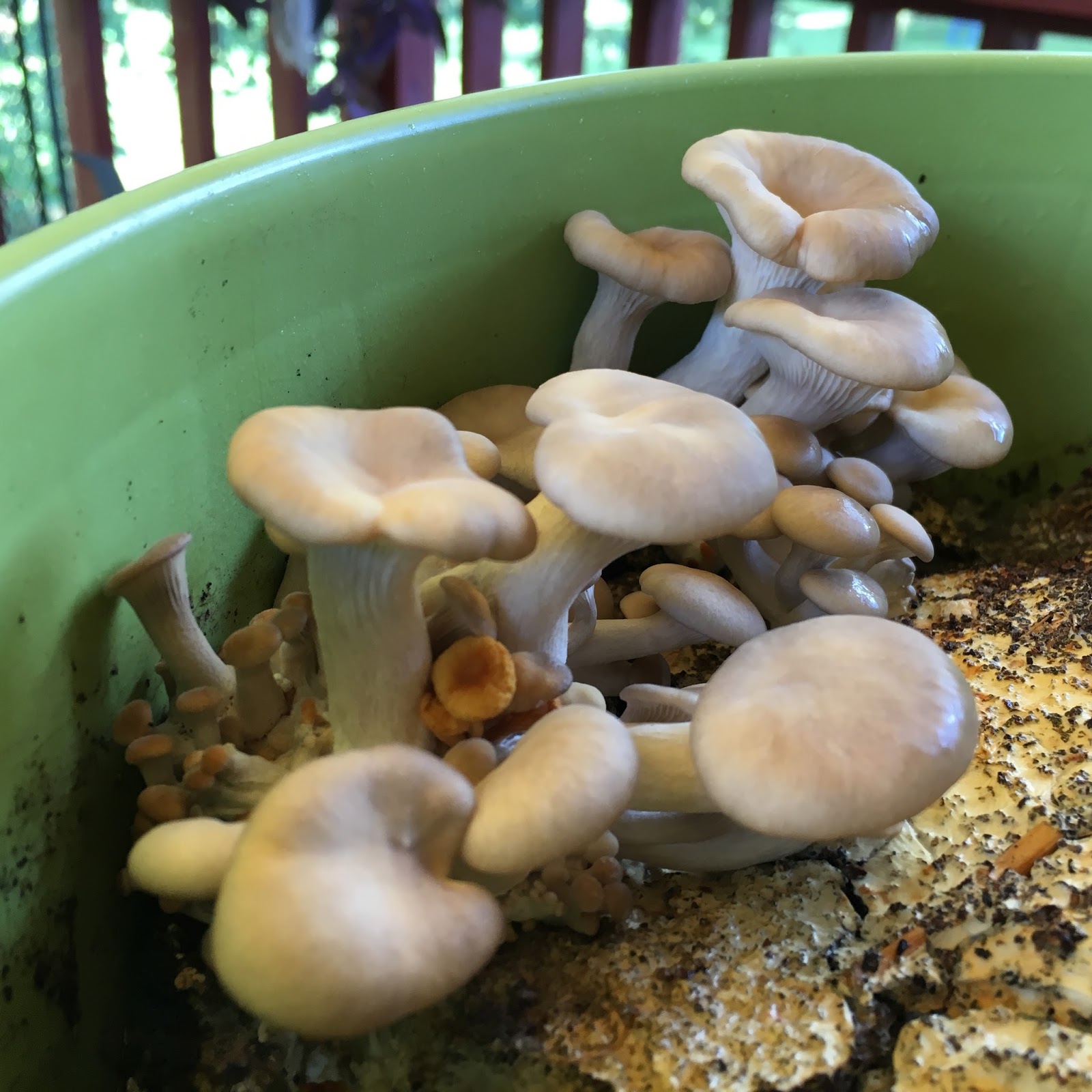
Two years ago, to understand more of the considerations, I put on my literary scientist hat and took a deep dive into all things mycological. I grew oyster mushrooms from a patch, bought the book, and took a weekend seminar Mycelium Running, by Paul Stamets. To the best of my ability I have marinated the entire story with what I learned with him and his team at Fungi Perfecti.

When I do classroom visits with Green Tara, the fifth and sixth graders are thrilled by the adventure, in which the main characters take action steps to regenerate bio-systems. I'm looking forward to taking Mission to Blue Grannus to the classroom, as well. 

We all need action steps, a game plan, for our land and water are under assault locally and globally. The question I try to answer in this series is How can we repair the damage humankind has wrought on our beautiful planet? 

Thursday, October 20, 2016

Lion's Mane:
Cognitive Boosts in a Writer's Life

Lion's Mane, Hercium erinaceus, with its distinctive shaggy look
Lion's mane is typically difficult to find in the wild, but earlier this week I spotted this beauty on a fallen tree a few steps off a city park trail. I left the lovely specimen tucked under some foliage undisturbed, hoping it will continue to grow and no one else will snag it before I return to harvest.

Though experts disagree on efficacy, lion's mane shows promise as a nerve regenerator that functions as a cognitive enhancer, as well as serving in traditional medicinal uses for a variety of health concerns, including digestive and cholesterol issues.

I've been getting another kind of cognitive boost this past week. I've been taking an online writing class from the University of Iowa, and in my first assignment I wrote a short story based on a character and an event that Virginia and Gordy witness in Mission to Green Tara. It's the moment when a colonial pod stuffed with "volunteers" from the cruise ship is released into deep space and dropped off in the middle of nowhere. The Maderas kids know the pod has no navigation, communication, or oxygen filtering capabilities. In other words, it's a death sentence for the volunteer colonists. Story structure wise, it's the moment when Virginia crosses the first threshold and takes action. Specifically, it's the moment when Virginia decides to defy authority in a really big way, escape from the massive cruise ship controlled by ruthless despots, and rescue her mother after a decade of being lost in space.

My new short story, "Release and Settlement," is told from the perspective of a young girl who is released with the volunteers. After fielding notes from my writing group and my revisions, I plan to submit the short story to sci-fi publications.

To learn more about why I write sci-fi eco-adventures, and to find out more about my work-in-progress and how writing Mission to Blue Grannus requires my research into fungi and myco-remediation, tap on KHBrower.com.

Wednesday, October 12, 2016

Digging Deeper:
Why Fungi Matters to Space Travelers


Fly Agaric, Amanita muscaria variety formosa.
past its prime and shrouded in a lacy, miscellaneous mold
My literary research includes thinking out loud with experts about what types of fungi space travelers would need and why.

For Mission to Blue Grannus, my work-in-progress, I sketched out the major beats of the story for both the plot line and what I call the heart line of the story. However, as I'm drafting I still must answer many detailed questions.  So even when I'd like to whip through scenes, simply adding words and paragraphs and pages to my manuscript, often I need to pause and dig deeper into the character's inner life and the demands of the natural world Gordy and Virginia encounter.

This past week I've been toggling back and forth between the emotional arc, the lessons that come out of Gordy's experience, and the scientific motivations of his mission.

Spoiler Alert! Here's a passage from my current draft of chapter 14. The Council Circle, in which the community's need for fungi is outlined:
     Jimmy continued, “The Blue Moon Trading Post is a regular stop for us and typically we would pick up mushrooms and fungi supplies for terraforming trade. Unfortunately, our normal contacts are missing, so we need to trade directly with the mushroom man, the primary source of product, supplies, and propagation knowledge.” 
     The crowd murmured, and I had an aha moment about the renegades around me. They werent just piratesthough thats how Id first known themthey were active in the terra-forming trade. As fungi were the absolute foundation of a healthy soil of a thriving ecosystem, and it made sense they would be involved. 
     I leaned over to Virginia and shared a memory. "Remember our fungi forays on Green Tara?" I explained to Lora and Lee, "On our planetary trek we hunted mushrooms for dinner." 
     "Better than cicadas!" Virginia screwed up her face in mock horror.
     I chuckled, remembering some of our more gruesome dinners. I asked Lora and Lee, Is terraforming the main business of the tribe?”   
     “Fungi, Lora said. 
     “… is our biz, Lee said. 
     “Mycelium networks, Lora said. 
     “ connect all of life, Lee said.
     “Fungi are valuable for,” Lora said. 
     “Terraformation,” Lee said.
     “Myco-remediation,” Lora said.
     “Medicinal extracts,” Lee said.
     “Medicine for things like radiation poisoning? Virginia asked. I knew that officially mushroom extracts were not considered effective beyond a general immune system boost, but renegades and colonial cruisers alike believed in them. So they'd be a valuable product to trade. The twins nodded. 
     “And you said myco-remediation. You mean using mushrooms to restore a compromised environment?" I'd seen signs of radiation poisoning in the Blue Moon Trading Post. "Near here? On the Grannus Moon?"
     "They poisoned ...," Lora nodded.
     "... the water," Lee nodded. 
     "All of it downstream ..., Lora said. 
     "... of the old dam," Lee said.
The decaying mushroom has one last
ecstatic reach to the sky.
Within hours of this snapshot
the delicate mold and most of
the mushroom body had disappeared.  
You may be wondering how my visuals of moldy mushrooms relate to this part of the story. They don't. But the magical, lacy fringe will most definitely make an appearance later in the story, once Gordy and Virginia make it farther upstream into the heart of the ice caves.

To learn more about why I write sci-fi eco-adventures, and to find out more about my work-in-progress and how writing Mission to Blue Grannus requires my research into fungi and myco-remediation, tap on KHBrower.com.


Wednesday, September 28, 2016

Foray at Griffy Lake Park:
Autumnal Equinox 2016

Aspen Bolete, perchance?
Spotting this magnificent beauty was the climax of an impromptu day hike with my dear friend, Shayne Laughter. The weather was perfect, we both had an unscheduled afternoon, and the stars were aligned.

We walked along the high trail, the north loop of the trail that starts at the far side of the dam. We got our feet wet crossing the spillway, but the day was warm and our shoes compatible with the conditions.

Griffy Lake Dam

We climbed the stairs to the left and entered the woods. It's a young forest. Where the land was once thick with old growth woods, several places have had as many as two clear cuts. Now the trees are almost all thin, and even the undergrowth is sparse, though we did see one mother tree and very distinct signs that the soil is healthy, rich with mycelium running.

From the moment we stepped into the shade, we encountered friends of the Fungi Kingdom. Look at all these beauties!
First of the foray. I've seen this one before
on the trail above Jackson Creek.

At the next bend in the trail,
we saw several of these.

Low-angle, underside view of the cap

One hillside was thick with this sponge type.
This group appear to have already sporulated.
They were stiff and dry to the touch.

This coral sample was springy to the touch,
in comparison to those above.

Dappled sunlight shines a spotlight on the magnificent bolete.

To learn more about why I write sci-fi eco-adventures, and to find out more about my work-in-progress and how writing Mission to Blue Grannus requires my research into fungi and myco-remediation, tap on KHBrower.com.

Wednesday, September 14, 2016

Turkey Tail Report: Trametes versicolor Makes a Home in My Back Yard

I first saw my turkey tail patch growing in the early summer following a lot of spring rain on a stump we use for chopping firewood. I wasn't sure, as I'm a novice mycologist, but it had the markers: the ringed color patterns and the nested groupings of the caps. Also, the top side of the caps were fuzzy to the touch. I checked my trusty reference guide and it said to look for whitish spores. But I couldn't see any spores. Perhaps those emerging caps were too young to produce spores. (note to self: Ask an experienced mycologist when the caps typically start producing spores. My guess is there are a number of factors, like air temperature and humidity, in addition to the maturity of the mushrooming body.)

Turkey Tail emerging, July 11, 2016

I didn't think my turkey tail -- and yes, I call it MY turkey tail, for I have abounding, familial affection for my back patio patch -- would thrive in its volunteer location here in Bloomington, Indiana. During midsummer this spot was destined to get full sun for several hours a day, and the stump is too heavy to move without a good reason.

But, before I asked my 6'4" son to roll it back under the shade of the deck so the mushrooms wouldn't struggle in the heat, it rained. It rained a lot here--all summer l-o-n-g. While the western states fried, the midwest flooded and my turkey tail thrived. Here's my mushroom stump a month later.

New growth after the storm, August 14th 
The other side of the stump with another, shorter-lived species, August 18

This past weekend I photographed my turkey tail again, after a couple of weeks of "normal" late summer weather, in other words, HOT. The patch is clearly thriving despite the heat. I love the green rings and wonder why one section of caps has developed a new color scheme. When I shared my pictures with my Mycelium Running seminar tribe, one cautioned my identification, saying she had encountered a turkey tail look-alike.

Is MY turkey tail really Trametes versicolor, or an imposter? September 10, 2016
Under the cap you can see the whitish pore openings where the spores come out -- shot with a macro lens.

So I asked a local mycology prof, Dr. Michael R. Tansey of Indiana University, to verify or set me straight. From the two photos pictured above, this is what he said:
"This is Turkey-tail.  It is our most common mushroom.  It is very common.  I have been out walking today, and it is abundant.  FYI:  Most experienced mushroom people agree that what we call the Turkey-tail is, at the level of analysis of the DNA, many different species.  Indeed, I have seen unpublished DNA data from our local specimens, and they cannot be one "real" species.  I remember one of the most experienced wood-rot fungi experts, years ago, telling me that it must be a dozen species."  
Ta Da! I'm thrilled I correctly identified fungi--even if not DNA-specific in my ID--in the wilds of my back yard. And now that the sun has dropped lower and the stump is in the shade for more of the day, I doubt anything will disturb my turkey tail, until we have really cold weather. Remember, turkey tail is everywhere. See if you can find some in your neighborhood.

To learn more about why I write sci-fi eco-adventures, and to find out more about my work-in-progress and how writing Mission to Blue Grannus requires my research into fungi and myco-remediation, tap on KHBrower.com.

P.S. If anyone has thoughts or recipes about making a medicinal extract, please send them my way. This literary scientist is ready to try most anything.

Tuesday, September 6, 2016

Oyster Mushroom Report 4 of 4:
Two More Clusters

Last week I left you with a real cliff hanger: after I harvested one cluster from my second flush, I saw emergent growth in a handful of clusters around the edge of the bucket.

Day 9 - primordia emerge from clusters that did not thrive in the first flush

Could I keep them happy enough to thrive, or would they shrivel and die in the summer heat or air conditioned air, or suffer oxygen deprivation from life under a humidity tent? There are several variables to consider when growing mushrooms outside a perfectly controlled, lab environment.

Day 10 - No guarantees, but hopeful growth.

Some days I carried the bucket back and forth, into my living room during the heat of the day and out to the screened-in deck for moist night air.

Day 11 - Cautious optimism is in order. The new growth has outpaced the fruit that did not thrive in the first flush.

Two of the five clusters in this third flush continued to thrive. Three did not.

Day 12 - Graceful formations in two clusters.

In the second flush I think I harvested a day too soon, before the outer edges arch upward.  (I'd been frustrated by the coral formation of the first flush and was impatient.) This time, I waited patiently.

Day 13 - The edges never arched upward -- apparently drooping in the heat.
This time I may have harvested a day later than prime, as the outer edges thinned and lost their hearty texture. Regardless, the results were pretty spectacular. Here they are ready to saute along with onions, potatoes and peppers. My son and husband approved of our Labor Day weekend supper.

The dark coffee grounds on the base of the clusters on the far left and top right, help show the growth pattern of a cluster of oyster mushrooms. 

I'll let you know if there's any more action in the bucket. Right now it's at rest, and I'm letting the bucket dry out. 

Meanwhile, I need to get back to a scene in Mission to Blue Grannus. Gordy and Virginia are preparing for their trek to the blue ice caves, where they hope to find the mushroom man.

To learn more about why I write sci-fi eco-adventures, and to find out more about my work-in-progress and how writing Mission to Blue Grannus requires my research into fungi and myco-remediation, tap on KHBrower.com.

Tuesday, August 30, 2016

Oyster Mushroom Report 3 of 4:
Second Flush is a Success

Day 1 - first flush of fruit 

One month after I inoculated coffee grounds in a bucket with healthy mycelium, 5 days after I trimmed back undesirable coral growth and gave the bucket more air by using the tent less and moving outside of the drying air-conditioning, I finally spot emergent mushrooms. These are a much healthier shape than the coral growth I saw last week. 

I'm calling this first siting Day 1.

I captured these tiny primorida using a macro lens.

Day 2 - rapid growth using regular iPhone camera lens

Day 2 - rapid growth


Here I'm pointing to the same cluster pictured above.

Day 3 - continued growth

The next day the growth rate slows a bit. 


Day 4 - close to harvest

The ideal shape for picking is just as the caps uncurl and reach upward creating a funnel shape, and before they flatten out too much.

Morning light on thriving oyster mushrooms. By evening they were ready to harvest and it was dark and I was hungry, so there's no picture of me sautéing these with garlic. Yummy.
Day 5 - after the harvest

At the same time the cluster pictured above had grown, I spotted another handful of clusters begin to emerge. I had high hopes that I'd enjoy a series of small flushes. 

I didn't think it would help to keep them inside for any length of time, because the air-conditioning would dry them out and the humidity tent seemed to starve them of oxygen. So I took the bucked outside.  

Unfortunately, the summer heat got extreme, rising to 90 degrees in the midday, and those temps are not most conducive to oysters. My hopes of more culinary delight were dashed as I watched them start to shrivel.

Day 8 - shriveled clusters

Disappointing, to say the least

Day 8 - 2 of 5 clusters - apparent failure to thrive
Day 9 - what next?


This morning, I was thinking about what I could do to coax more activity from the mycelium patch I've created, and look what I found: fresh emergent growth!

Day 9 - white emergent growth appears around the clusters that didn't thrive. 

I'll let you know what happens next week. 

To learn more about why I write sci-fi eco-adventures, and to find out more about my work-in-progress and how writing Mission to Blue Grannus requires my research into fungi and myco-remediation, tap on KHBrower.com.