For more about why this author writes sci-fi eco-adventures, visit her website: KHBrower.com
Showing posts with label eco-warrior. Show all posts

Wednesday, May 16, 2018

"Mission to Blue Grannus" Novel Update

The most consistent thing readers of Green Tara have said is, "When can I read the next one?" And indeed the novel was always meant to be the first in a trilogy. Now, I have a follow-up novel that should be ready late this year. 

The setting for Mission to Blue Grannus is inspired by ice caves that form during high winds and deep freezes. These conditions occur here on Earth on Lake Michigan and Lake Superior, where waves freeze solid and swells become ice caves. 
This new one, Mission to Blue Grannus, picks up two years after the end of Green Tara, when the pirate twins invite Gordy, now 15, to join them in a rescue mission. The pirate ship arrives at the edge of the Grannus system soon after his family. They're avoiding a Triumvirate engineering crew sent to reopen a toxic mine on the blue ice moon. 

The Grannus System was at a crossroads. The outer ring is volatile, with a crack in dimensions that offered a faster than light pathway to a network of destinations, including her mom's last known location, and they needed to find her. 

Also, the crossroads was about power and who controls the land and water. On Blue Grannus the original mine had closed decades ago, leaving the miners behind, abandoned refugees. One faction of the refugees lives deep in the blue ice caves, where the mushroom man cultivates strains of mycelia to myco-remediate the moon's toxic water. 
For more stunning landscapes that inspired my story world for this part of Gordy's journey, see these photos by Heather Higham.
The scientific inspiration of Blue Grannus comes from world mycology expert Paul Stamets. I saw his TED talk "How Mushrooms Can Save the World" and immediately understood the implications of his research for repairing damage to our Earth, and also for my sci-fi future vision of human terraforming and myco-remediation efforts. So, just as book 1 was inspired by invisible, essential phytoplankton in the ocean, book 2 is inspired by invisible and essential mycelium networks, the underground rootlike systems of the Fungi Kingdom, and the myco-remediation action of those networks. 

In my story world on the Blue Ice Moon orbiting the gas giant of the Grannus System, the Trivert mining engineers are starting up tests again. Orders from the board were to apply new techniques in the extraction process to yield gold and other precious metals, even though these new methods would put human  refugees at further risk by unleashing even more toxic chemicals into their water system. Gordy and his cousin Virginia, my teenage eco-warrior heroes, volunteer to help the pirates and the refugees make a trade that will protect their myco-remediation efforts. 
The power of mycelial networks to remediate poisoned water is a perfect fit for Mission to Blue GrannusFrom Radical Mycology, here's a clear 1-page overview of myco-remediation: https://radicalmycology.com/educational-tools/human-uses-of-mushrooms/mycoremediation-101/
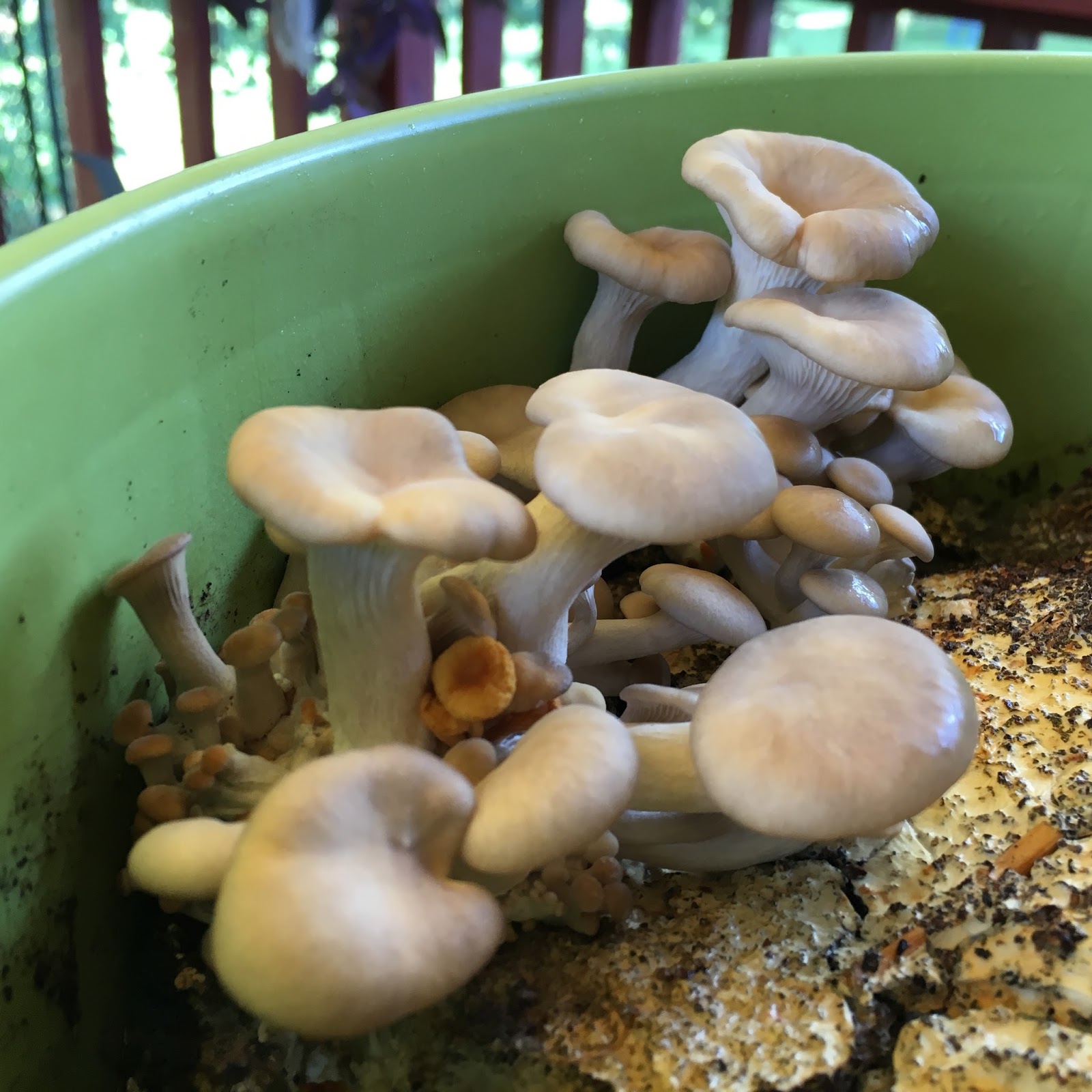
Two years ago, to understand more of the considerations, I put on my literary scientist hat and took a deep dive into all things mycological. I grew oyster mushrooms from a patch, bought the book, and took a weekend seminar Mycelium Running, by Paul Stamets. To the best of my ability I have marinated the entire story with what I learned with him and his team at Fungi Perfecti.

When I do classroom visits with Green Tara, the fifth and sixth graders are thrilled by the adventure, in which the main characters take action steps to regenerate bio-systems. I'm looking forward to taking Mission to Blue Grannus to the classroom, as well. 

We all need action steps, a game plan, for our land and water are under assault locally and globally. The question I try to answer in this series is How can we repair the damage humankind has wrought on our beautiful planet? 

Thursday, July 20, 2017

Back Roads Eco-Warrior series:
Dr. Nancy Dawson

Dr. Nancy Dawson shows some of the
produce from her community gardens 
Last month, I had the opportunity to work on a short film shoot in the small, picturesque city of Russellville, Kentucky. One of the greatest pleasures in a week full of amazing performances and a vibrant crew was meeting Dr. Nancy Dawson. As a historian, she costumed the 1850's story set on a slave plantation. She also played one of the character parts.

And after all that creative awesomeness I found out Dawson is also the Director of the Russellville Urban Gardening Project (RUGP). She's passionate about Gardening for Engagement and the educational programs she's developed around her concept of revitalizing and uplifting her community through the practice of horticulture.

She gave me a tour of her gardens, starting in her backyard in the historic neighborhood.

Dawson started growing her own food after a health crisis, and her realization that she needed to radically alter her personal consumption, meaning fresh, highly nutritious foods needed to replace sugars and empty starches that worsened her health. Though she had no formal training in agriculture, she remembered family and neighbors growing fruits and vegetables in her childhood, so she started to grow some of her favorite vegetables.

Some of the neighborhood kids would come around and ask about the plants, not recognizing peppers or tomatoes. "I realized they thought these things came from Walmart." As a lifetime educator, she got to work filling the knowledge gap.

One of the hoop structures in the
Russellville Urban Gardening Project
Starting with a 4H garden club, which she held on her back porch, her idea for more education grew. Simultaneously, her garden has grown from the pots on her back deck, to an intensive bed, to the three-acre community garden in the heart of the Russellville's black neighborhood.

This year RUGP is piloting an educational program in the local high school. Dawson's plan is for students to use technology for research and for writing field reports. Throughout the semester they'll have opportunities to meet with reps from Kentucky State University to learn about higher ed and careers in agriculture. Dawson's program also includes the high schoolers building an aquaponics garden. I hope to return for another tour!

Access to more variety in fresh foods is a prime benefit for the community. Also--this close to my heart--gardening for engagement includes teaching the value and importance of preservation and protection of nature and the environment.

Radical idea? Dawson herself says she's a change agent.

To find out more about my Back Roads project, currently in development, watch this teaser:


Wednesday, November 9, 2016

Water Is Life: Prayers from Standing Rock

Alice Brown Otter, age 12, of the Standing Rock Sioux.
I first became aware of what was happening at Standing Rock, North Dakota, when I saw this story from MSNBC and Alice Brown Otter captured my heart. I've been writing about fictional eco-warriors of the future, and now my attention has turned to Alice and present day eco-warriors on the front lines. She and other kids from the Defenders of the Water School are my real life heroes.

Last summer Alice ran to Washington D.C. to petition government agencies to protect the water of her home. Meanwhile, thousands of water protectors have congregated in one of the most remote areas of North Dakota. Indigenous people and their allies from all over the world have come to camp on the bluffs overlooking Lake Oahe, where the Cannonball River joins the and Missouri watershed.
Map by cartographer Carl Sack
The Mni Wiconi, Water is Life movement, gained its recent momentum when LaDonna Brave Bull Allard saw an oil company's plan to build a pipeline just north and upriver from her home on Sioux Reservation land and under the great Missouri River. Allard and her tribe know oil pipelines break regularly, and this was their source of drinking water. So, the Sioux elders began to pray. They know that water is sacred. Water is life.

The women at the forefront of #NoDAPL say they are water protectors, not protesters. This is an important distinction, for the heart of our country shares the Missouri and Mississippi watershed and the water they are protecting belongs to us all.

Since early September, water protectors have been the brunt of escalating violence from militarized police forces sent by the state and county to protect oil interests. The forces deploy long-range acoustic devices, chemical weapons, non-lethal beanbag shot, batons, and even attack dogs.

Josh Fox, director of Gasland (available on Netflix), talks about human rights violations in a "Police State of Oil-igarchy"


Future Developments
Friday, December 4th, dialog between tribal leaders and the Army Corps of Engineers bodes well. The conversation has focused around seeking delays in construction and permitting until full studies can be conducted. But this is an unfolding story, and the outcome of the dialog meetings (there are a series over the upcoming weeks) would be speculative at this point. The hope is for a de-escalation of violence.

Even before the beginning of dialog, the women of Standing Rock planned a Forgiveness March on November 6th to the Morton County Sheriff's office in Mandan, North Dakota.


On land adjacent the Cannonball River, Standing Rock Sioux plan to build their Just Transition Community, an eco-village with earth lodge and straw bale construction and solar and wind power. This building plan is already approved by the federal agency, Bureau of Indian Affairs.

To learn more about why I write sci-fi eco-adventures, and to find out more about my work-in-progress and how writing Mission to Blue Grannus requires my research into how real life eco-warriors engage with their world, tap on KHBrower.com.

Remember, we are all connected. For your appreciation, here are images of our shared watershed.

For more in-depth reading:
NoDAPL map
Historical timeline and in-depth Standing Rock syllabus (from indigenous scholars and allies)
New Yorker (historical context)
The Atlantic (destruction of archeological sites)
New York Times (current situation)
Time (legal context about Sioux land that's "held in trust" by the U.S. government)
EcoWatch (meet the women leading the water protectors)
Yes! Magazine (Lakota prophecy of the black snake)


Wednesday, October 5, 2016

Daily Rhythm & Pace of Author Activities

Often it feels like I'm taking one baby step at a time,
without a clear path more than a step or two ahead of me.
Ever since my spectacular bicycle accident I have been developing new habits around writing. I pay attention to when and where my body needs to stretch and elongate. Doctor's orders. Sometimes I stand to write. Sometimes I speak into an audio recorder while I pace and voice recognition software translates my spoken words to text. Right now I'm at a regular height desk on a bouncy chair made of bungee cords, but I know I cannot sit for long at any one time. So, I pace myself and throughout the day I integrate my hands-on research into my daily actions.

I take care of a short section of a stream,
picking up trash and keeping a log of water quality.
For example, this morning I took my dog Lucy for a walk with my writerly friend, M., in our favorite local park. We catch up on family and home remodel stories, and often discuss how we're handling a particular rewrite or a breakthrough in how we've found to connect with our readers.

When we crossed the creek I saw how low the water is right now. We've had rain all summer, so the partially dry creek bed exposed all sorts of trash. I'm an adopt-a-stream volunteer for our Parks Department and this section is mine, so I got my trash picker, bag, and badge and did my civic duty.

Three Sisters is a classic southwest
American Indian combination of
squash, beans and corn
Then I came home and  prepared a bowl of Three Sisters, dancing while I heated and stirred. After my brunch and a short burst of writing (the first draft of this post), I managed several pieces of business communication and scheduling.

The pattern of a typical writing day for me includes:
  • Move - dance/swim/walk
  • Cooking meditation
  • Write for a short burst 
  • Connect with other creative partners and champions
  • Hands-on research
  • Eco-warrior actions
  • Read 
  • Repeat, with loose variations 
What I look for in each day is a healthy balance. I write about eco-warriors and scientists, so each day I incorporate activities that at least honor the spirit of intention of the heroes in my adventure stories.

To learn more about why I write sci-fi eco-adventures, and to find out more about my work-in-progress and how writing Mission to Blue Grannus requires my research into fungi and myco-remediation, tap on KHBrower.com.

Wednesday, September 14, 2016

Turkey Tail Report: Trametes versicolor Makes a Home in My Back Yard

I first saw my turkey tail patch growing in the early summer following a lot of spring rain on a stump we use for chopping firewood. I wasn't sure, as I'm a novice mycologist, but it had the markers: the ringed color patterns and the nested groupings of the caps. Also, the top side of the caps were fuzzy to the touch. I checked my trusty reference guide and it said to look for whitish spores. But I couldn't see any spores. Perhaps those emerging caps were too young to produce spores. (note to self: Ask an experienced mycologist when the caps typically start producing spores. My guess is there are a number of factors, like air temperature and humidity, in addition to the maturity of the mushrooming body.)

Turkey Tail emerging, July 11, 2016

I didn't think my turkey tail -- and yes, I call it MY turkey tail, for I have abounding, familial affection for my back patio patch -- would thrive in its volunteer location here in Bloomington, Indiana. During midsummer this spot was destined to get full sun for several hours a day, and the stump is too heavy to move without a good reason.

But, before I asked my 6'4" son to roll it back under the shade of the deck so the mushrooms wouldn't struggle in the heat, it rained. It rained a lot here--all summer l-o-n-g. While the western states fried, the midwest flooded and my turkey tail thrived. Here's my mushroom stump a month later.

New growth after the storm, August 14th 
The other side of the stump with another, shorter-lived species, August 18

This past weekend I photographed my turkey tail again, after a couple of weeks of "normal" late summer weather, in other words, HOT. The patch is clearly thriving despite the heat. I love the green rings and wonder why one section of caps has developed a new color scheme. When I shared my pictures with my Mycelium Running seminar tribe, one cautioned my identification, saying she had encountered a turkey tail look-alike.

Is MY turkey tail really Trametes versicolor, or an imposter? September 10, 2016
Under the cap you can see the whitish pore openings where the spores come out -- shot with a macro lens.

So I asked a local mycology prof, Dr. Michael R. Tansey of Indiana University, to verify or set me straight. From the two photos pictured above, this is what he said:
"This is Turkey-tail.  It is our most common mushroom.  It is very common.  I have been out walking today, and it is abundant.  FYI:  Most experienced mushroom people agree that what we call the Turkey-tail is, at the level of analysis of the DNA, many different species.  Indeed, I have seen unpublished DNA data from our local specimens, and they cannot be one "real" species.  I remember one of the most experienced wood-rot fungi experts, years ago, telling me that it must be a dozen species."  
Ta Da! I'm thrilled I correctly identified fungi--even if not DNA-specific in my ID--in the wilds of my back yard. And now that the sun has dropped lower and the stump is in the shade for more of the day, I doubt anything will disturb my turkey tail, until we have really cold weather. Remember, turkey tail is everywhere. See if you can find some in your neighborhood.

To learn more about why I write sci-fi eco-adventures, and to find out more about my work-in-progress and how writing Mission to Blue Grannus requires my research into fungi and myco-remediation, tap on KHBrower.com.

P.S. If anyone has thoughts or recipes about making a medicinal extract, please send them my way. This literary scientist is ready to try most anything.

Tuesday, September 6, 2016

Oyster Mushroom Report 4 of 4:
Two More Clusters

Last week I left you with a real cliff hanger: after I harvested one cluster from my second flush, I saw emergent growth in a handful of clusters around the edge of the bucket.

Day 9 - primordia emerge from clusters that did not thrive in the first flush

Could I keep them happy enough to thrive, or would they shrivel and die in the summer heat or air conditioned air, or suffer oxygen deprivation from life under a humidity tent? There are several variables to consider when growing mushrooms outside a perfectly controlled, lab environment.

Day 10 - No guarantees, but hopeful growth.

Some days I carried the bucket back and forth, into my living room during the heat of the day and out to the screened-in deck for moist night air.

Day 11 - Cautious optimism is in order. The new growth has outpaced the fruit that did not thrive in the first flush.

Two of the five clusters in this third flush continued to thrive. Three did not.

Day 12 - Graceful formations in two clusters.

In the second flush I think I harvested a day too soon, before the outer edges arch upward.  (I'd been frustrated by the coral formation of the first flush and was impatient.) This time, I waited patiently.

Day 13 - The edges never arched upward -- apparently drooping in the heat.
This time I may have harvested a day later than prime, as the outer edges thinned and lost their hearty texture. Regardless, the results were pretty spectacular. Here they are ready to saute along with onions, potatoes and peppers. My son and husband approved of our Labor Day weekend supper.

The dark coffee grounds on the base of the clusters on the far left and top right, help show the growth pattern of a cluster of oyster mushrooms. 

I'll let you know if there's any more action in the bucket. Right now it's at rest, and I'm letting the bucket dry out. 

Meanwhile, I need to get back to a scene in Mission to Blue Grannus. Gordy and Virginia are preparing for their trek to the blue ice caves, where they hope to find the mushroom man.

To learn more about why I write sci-fi eco-adventures, and to find out more about my work-in-progress and how writing Mission to Blue Grannus requires my research into fungi and myco-remediation, tap on KHBrower.com.

Tuesday, August 30, 2016

Oyster Mushroom Report 3 of 4:
Second Flush is a Success

Day 1 - first flush of fruit 

One month after I inoculated coffee grounds in a bucket with healthy mycelium, 5 days after I trimmed back undesirable coral growth and gave the bucket more air by using the tent less and moving outside of the drying air-conditioning, I finally spot emergent mushrooms. These are a much healthier shape than the coral growth I saw last week. 

I'm calling this first siting Day 1.

I captured these tiny primorida using a macro lens.

Day 2 - rapid growth using regular iPhone camera lens

Day 2 - rapid growth


Here I'm pointing to the same cluster pictured above.

Day 3 - continued growth

The next day the growth rate slows a bit. 


Day 4 - close to harvest

The ideal shape for picking is just as the caps uncurl and reach upward creating a funnel shape, and before they flatten out too much.

Morning light on thriving oyster mushrooms. By evening they were ready to harvest and it was dark and I was hungry, so there's no picture of me sautéing these with garlic. Yummy.
Day 5 - after the harvest

At the same time the cluster pictured above had grown, I spotted another handful of clusters begin to emerge. I had high hopes that I'd enjoy a series of small flushes. 

I didn't think it would help to keep them inside for any length of time, because the air-conditioning would dry them out and the humidity tent seemed to starve them of oxygen. So I took the bucked outside.  

Unfortunately, the summer heat got extreme, rising to 90 degrees in the midday, and those temps are not most conducive to oysters. My hopes of more culinary delight were dashed as I watched them start to shrivel.

Day 8 - shriveled clusters

Disappointing, to say the least

Day 8 - 2 of 5 clusters - apparent failure to thrive
Day 9 - what next?


This morning, I was thinking about what I could do to coax more activity from the mycelium patch I've created, and look what I found: fresh emergent growth!

Day 9 - white emergent growth appears around the clusters that didn't thrive. 

I'll let you know what happens next week. 

To learn more about why I write sci-fi eco-adventures, and to find out more about my work-in-progress and how writing Mission to Blue Grannus requires my research into fungi and myco-remediation, tap on KHBrower.com.