For more about why this author writes sci-fi eco-adventures, visit her website: KHBrower.com

Tuesday, September 6, 2016

Oyster Mushroom Report 4 of 4:
Two More Clusters

Last week I left you with a real cliff hanger: after I harvested one cluster from my second flush, I saw emergent growth in a handful of clusters around the edge of the bucket.

Day 9 - primordia emerge from clusters that did not thrive in the first flush

Could I keep them happy enough to thrive, or would they shrivel and die in the summer heat or air conditioned air, or suffer oxygen deprivation from life under a humidity tent? There are several variables to consider when growing mushrooms outside a perfectly controlled, lab environment.

Day 10 - No guarantees, but hopeful growth.

Some days I carried the bucket back and forth, into my living room during the heat of the day and out to the screened-in deck for moist night air.

Day 11 - Cautious optimism is in order. The new growth has outpaced the fruit that did not thrive in the first flush.

Two of the five clusters in this third flush continued to thrive. Three did not.

Day 12 - Graceful formations in two clusters.

In the second flush I think I harvested a day too soon, before the outer edges arch upward.  (I'd been frustrated by the coral formation of the first flush and was impatient.) This time, I waited patiently.

Day 13 - The edges never arched upward -- apparently drooping in the heat.
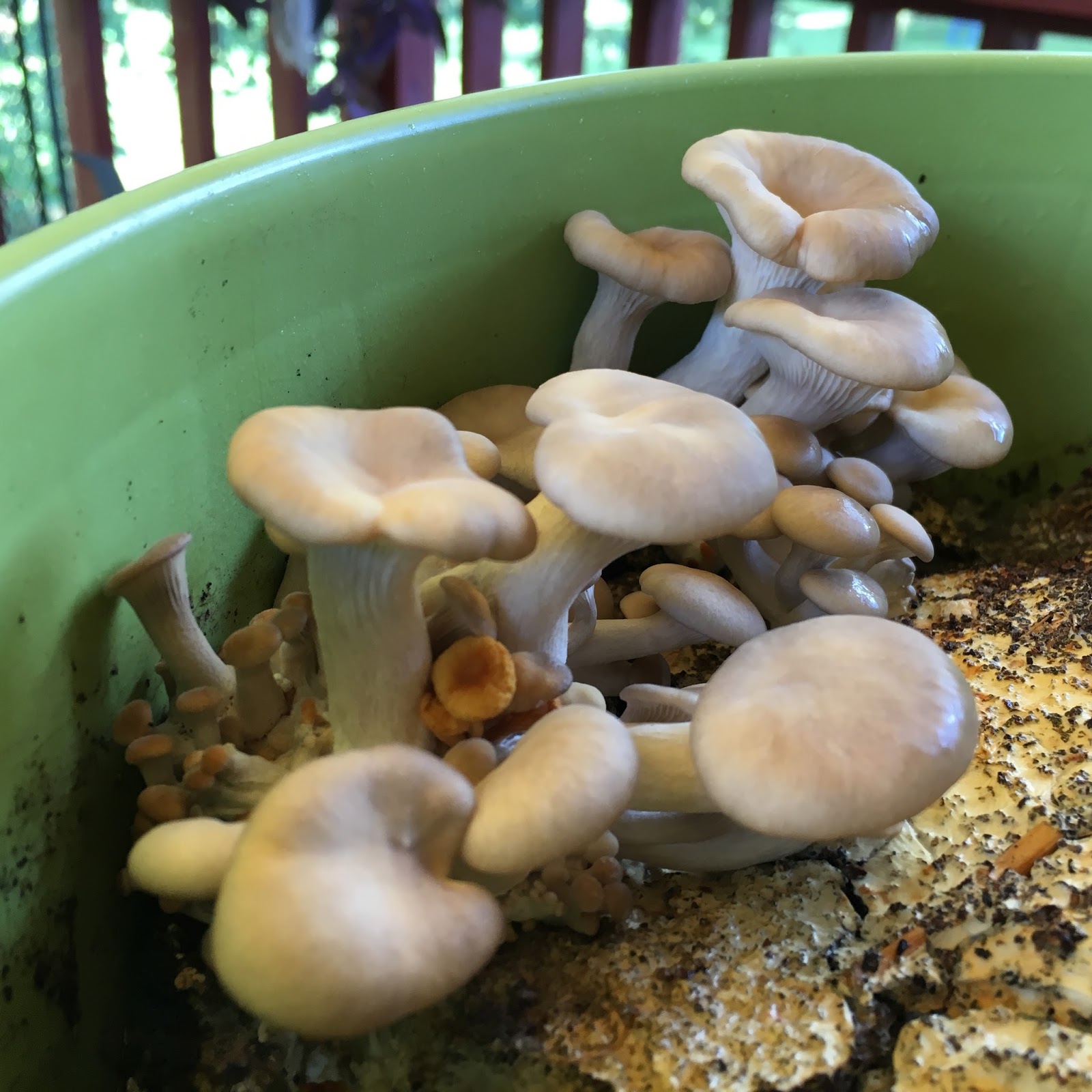
This time I may have harvested a day later than prime, as the outer edges thinned and lost their hearty texture. Regardless, the results were pretty spectacular. Here they are ready to saute along with onions, potatoes and peppers. My son and husband approved of our Labor Day weekend supper.

The dark coffee grounds on the base of the clusters on the far left and top right, help show the growth pattern of a cluster of oyster mushrooms. 

I'll let you know if there's any more action in the bucket. Right now it's at rest, and I'm letting the bucket dry out. 

Meanwhile, I need to get back to a scene in Mission to Blue Grannus. Gordy and Virginia are preparing for their trek to the blue ice caves, where they hope to find the mushroom man.

To learn more about why I write sci-fi eco-adventures, and to find out more about my work-in-progress and how writing Mission to Blue Grannus requires my research into fungi and myco-remediation, tap on KHBrower.com.

Tuesday, August 30, 2016

Oyster Mushroom Report 3 of 4:
Second Flush is a Success

Day 1 - first flush of fruit 

One month after I inoculated coffee grounds in a bucket with healthy mycelium, 5 days after I trimmed back undesirable coral growth and gave the bucket more air by using the tent less and moving outside of the drying air-conditioning, I finally spot emergent mushrooms. These are a much healthier shape than the coral growth I saw last week. 

I'm calling this first siting Day 1.

I captured these tiny primorida using a macro lens.

Day 2 - rapid growth using regular iPhone camera lens

Day 2 - rapid growth


Here I'm pointing to the same cluster pictured above.

Day 3 - continued growth

The next day the growth rate slows a bit. 


Day 4 - close to harvest

The ideal shape for picking is just as the caps uncurl and reach upward creating a funnel shape, and before they flatten out too much.

Morning light on thriving oyster mushrooms. By evening they were ready to harvest and it was dark and I was hungry, so there's no picture of me sautéing these with garlic. Yummy.
Day 5 - after the harvest

At the same time the cluster pictured above had grown, I spotted another handful of clusters begin to emerge. I had high hopes that I'd enjoy a series of small flushes. 

I didn't think it would help to keep them inside for any length of time, because the air-conditioning would dry them out and the humidity tent seemed to starve them of oxygen. So I took the bucked outside.  

Unfortunately, the summer heat got extreme, rising to 90 degrees in the midday, and those temps are not most conducive to oysters. My hopes of more culinary delight were dashed as I watched them start to shrivel.

Day 8 - shriveled clusters

Disappointing, to say the least

Day 8 - 2 of 5 clusters - apparent failure to thrive
Day 9 - what next?


This morning, I was thinking about what I could do to coax more activity from the mycelium patch I've created, and look what I found: fresh emergent growth!

Day 9 - white emergent growth appears around the clusters that didn't thrive. 

I'll let you know what happens next week. 

To learn more about why I write sci-fi eco-adventures, and to find out more about my work-in-progress and how writing Mission to Blue Grannus requires my research into fungi and myco-remediation, tap on KHBrower.com.

Tuesday, August 23, 2016

Oyster Mushroom Report 1 of 4:
How to Inoculate Coffee Grounds

Clusters of primordia surfaced yesterday, one month after I first inoculated the substrate of coffee grounds. Here each of the mushrooms is less than .5 centimeters in diameter. Today they're at least twice as large and, if all goes well, they'll continue to grow rapidly.

To inoculate your substrate (in my case coffee grounds, but you can use other growing mediums), the absolutely first thing you need is to secure your oyster mushroom spawn with mycelium running throughout. My spawn and how to knowledge came from Fungi Perfecti. (They are my go-to resource, and I'm simply showing you that anyone can do this.) There are other commercial sources for mushroom spawn, as well.

These are the supplies I used:
  • 5 gallon plastic bucket 
  • 4-5 pounds of used coffee grounds to use as the substrate/growing medium - free from my local Starbucks, so a very urban/suburban option (Note: If you don't use the grounds right away, you can freeze until you're ready so they don't get skanky.)
  • disposable gloves - wear whenever touching the inside of the bucket or any of the spawn or substrate (coffee grounds)
  • rubbing alcohol and a clean rag
  • oyster mushroom spawn 
Once you have all your supplies, start by preparing the bucket. Drill air holes near the top for air and in the bottom for drainage. (I set the bucket on a large saucer and both atop a stool, so I can easily move my experiment, as needed, to optimum light, temperature, and humidity.) 

The day of inoculation:
  1. Sterilize your bucket with soap and water, then a final rinse of rubbing alcohol. (Remember to wear gloves and/or sanitize your hands with the alcohol before touching the clean bucket.)
  2. Pasteurize your substrate. (I boiled used coffee grounds in non-chlorinated water for 30 minutes and let cool before pouring into my bucket.) 
  3. Mix the coffee grounds with the spawn.


Wait for the mycelium to colonize the bucket. In my case, I saw the first signs of healthy growth in five days.


Wait some more. 

Depending on your results, adjust conditions. In my case, it took a full month from inoculation to seeing mushrooms beginning to fruit. (Last week I showed you what happened when my first flush of oyster mushrooms sprouted in an undesirable coral formation. So, I removed the coral and the plastic humidity tent to provide more oxygen and misted the surface with a diluted hydrogen peroxide solution to treat suspicious, possibly competing green mold.

I'm finally getting good results. Fingers crossed. I'll take pictures every day to record mushroom progress and report next week!

To learn more about why I write sci-fi eco-adventures, and to find out more about my work-in-progress and how writing Mission to Blue Grannus requires my research into fungi and myco-remediation, tap on KHBrower.com.

Tuesday, August 16, 2016

Oyster Mushroom Report 2 of 4:
Overnight Growth is Coral-shaped

Oyster Mushroom Bucket Experiment
This morning I was aghast to find my oyster mushroom bucket experiment and, when successful, culinary treat had grown coral-shaped formations overnight.

My first flush of mushrooms doesn't have enough flesh to make a meal.

Coral-shaped formation--elegant shapes, but undesirable for an oyster mushroom.
This undesirable coral formation has one of two causes:
  1. not enough light
  2. not enough oxygen; too much carbon dioxide
I've had the oyster mushroom bucket in a western facing bay window, where it gets ample indirect light--ideal for this method of propagation. So, I deduce that the cause is not enough oxygen.

I was using a plastic tent to keep the bucket humid. Though I have ventilation holes and three times a day pull the tent off to let the carbon dioxide escape, I deduce I needed to give the patch more time to air each day.

Oyster Mushroom Bucket -- Out for Fresh Air
The weather is perfect today--70 degrees F and raining--so I took the oyster mushroom bucket to my screened in porch. I plan to trim the coral formations and hope for a second flush of edibles.

Pale Green/Gray Mold
Note: Even the coral doesn't grow here.
Near three of the air holes--where I may have carelessly touched the patch to clear coffee grounds away from the hole--first indications of mold appeared today. This is another undesirable development in my experiment, but easy to correct. In the past, light, regular misting of a mild hydrogen peroxide solution has worked for me.


The three steps I plan to take to encourage a second flush of healthy Oyster mushrooms:
  1. give the patch more fresh air
  2. trim the coral back to the mycelium
  3. spray the green mold with hydrogen peroxide solution 
In my next report, I'll give the steps I took to inoculate coffee ground substrate with the spawn I prepared in a June seminar led by Paul Stamets: Mycelium Running: How Mushrooms Can Save the World.

To learn more about why this author writes sci-fi eco-adventures, and to find out more about her work-in-progress and how writing Mission to Blue Grannus requires her research into fungi and myco-remediation, tap on KHBrower.com.
Thank you, Fungi Perfecti, for supplies, training, and inspiration!


Sunday, August 14, 2016

Turkey Tail - After a Summer Storm

Turkey Tail is well-known as a medicinal mushroom, generally beneficial to the immune system and specifically used for cancer treatment. This volunteer emerged here on my back patio five weeks ago.

Thursday, March 10, 2011

Reversible Metabolic Hibernation, a Gift of Immortality

Sci-fi geeks like me dream of technology that will allow astronauts to travel long distances and terra-forming scientists to sleep while a new planet’s evolution works its magic. But why wait for futuristic cryo tubes? Science research has caught up with our dreams!

Watch the 2010 TED talk by Mark Roth. He’s found a way to put mammals into a state of suspended animation, keep them cold, and then reanimate them.


Mark Roth and his team are very close to finding a practical way to make this happen for humans now, maybe this year, certainly in this decade. He calls it “reversible metabolic hibernation” and he wants EMT crews to put people who are experiencing life-threatening medical trauma into suspended animation, until they can be given the life-saving care they need. Then the individual will be reanimated, receiving a gift of immortality.

For more history on the practice of human hibernation, intentional and accidental, see my longer article on GeekMom.com.

Thursday, March 3, 2011

Scary Mother-Daughter Sex Talk Made Easy: Try a Matinee of The Vagina Monologues

Picture this: A beautiful, 16-year-old girl, a bright A-student, a good kid, my daughter. Her main extra-curricular activities are the marching and jazz bands, and now she’s been dating her first love, another band geek, for almost one year. He’s adorable, funny, and a true gentleman. What a relief that my girl is sweet on a boy I truly like, and I'm happy for her that she has someone who lets her know how special she is.

Here’s the problem: I’m afraid that it’s time for the big sex talk. Statistically, it may be past time.

It's not that we've never covered the mechanics of sex and procreation. Those talks have been ongoing. But this is definitely different and scary. This isn't just the theoretical facts. Now there are feelings involved.

My sex professor friend, Dr. Debby Herbenick, sexual health educator at Indiana University and the Kinsey Institute, suggested I take my daughter to a movie that features a sexual relationship, and use talking about the fictional story as a way to open the conversation.

A movie, of course! After all, we'd seen Juno together. (And I highly recommend this film about a smart teen who navigates her unexpected pregnancy.) But, when I checked the listings I found that late winter is the season of thrillers and super-hero movies.

Then, I found something better. Saturday I took my girl out to a matinee performance of The Vagina Monologues. It has everything. In the interactive portion of the show, we named body parts until the word vagina is no longer embarrassing to say. We heard a story about a woman, so ashamed of her sexual desire and physical response, that she's spent a lifetime shut off from "down there." We celebrated pleasure with a comic rendition of orgasmic moans. We cried for rape victims. We laughed at a woman railing about the indignity of a cold speculum. My daughter and I shared every emotion, along with a loving community of women and men.

And afterward, when I thought the time was ripe for our big talk, I simply told her if she was ever scared or confused or hurt that she could talk to me. (Note to self: Do NOT freak out, when and if she tells me something uncomfortable.)

Really? That's it? The Big Sex Talk? It turns out, there really wasn't much else to say. It turns out, the biggest part of my Big Sex Talk was how much I needed to lower my fear and open my heart.

I realized my daughter already understands everything I could tell her now. We've been having the conversation for years. Every time we've seen a television program, a movie, or a play together. Every book we've read and discussed. Every side comment and giggle. Every roll of the eye. Sex for procreation and sex for pleasure have always been part of the discourse between us. How could it not be?

And I also realize that I trust my daughter to know when she's ready to "cash in her V-card." Of course I don't want her to grow up too fast. There will always be a part of me that remembers when she was born. She's my baby girl. But she's also growing into a gorgeous young woman. And her sexual life is her own. The most important thing, the big thing I want her know is that I trust her to make her own choices.

For more information and resources, see my longer article about having the Big Sex Talk at GeekMom.com.